30 novembre 2012

Eclairage 2supports+2 flash+2softboxes50x70+1réf

Eclairage 2supports+2 flash+2softboxes50x70+1réf Ensemble complet d'éclairage studio pro 2 supports + 2 flash + 2 softboxes 50 x 70 cm + 2 réflecteur 2 en 1

Ensemble de studio complet : 2 supports + 2 flash + 2 softboxes 50 x 70 cm + 2 réflecteurs 2 en 1.

Nos lampes offrent un flux lumineux de haute intensité, elles sont rapidement prêtes pour le déclenchement suivant et bénéficient d'une longue durée de vie.

Les softboxes adoucissent la lumière de l'image, les ombres sont ainsi moins prononcées et plus subtiles.

Le flash de studio est adapté à la photographie numérique et argentique. Les ajustements peuvent être faits facilement via le panneau arrière. Le changement du flash de sortie est progressif et non-graduel. Le flash peut être utilisé comme lumière principale ou secondaire. Le flash peut être déclenché aavec le bouton test, par le cordon de synchro-flash ou bien déclenché par la cellule photoélectrique sur le haut du boîtier. La cellule photoélectrique réagit au flash de l'appareil, à d'autres flashs clignote (power trip) et à la manette du flash. Le temps de recharge après déclanchement est de 0,5 - 2 secondes (pour une charge complète).

Ce flash de studio est un flash à commande simplifiée, il convient aussi bien aux photographes professionnels qu'aux débutants. Les réglages peuvent être faits facilement via l'interface se situant à l'arrière du produit. Il se déclenche via le bouton de test, grâce au cordon de synchronisation et par une touche sur le boîtier directement. De plus, changer sa puissance est devenu très facile et il peut être utilisé aussi bien en éclairage principal qu'en éclairage latéral.

Le réflecteur vous permettra de renvoyer la lumière du flash ou du soleil, de manière précise et simple sans modifier les couleurs réelles.

Les trépieds ont des attaches filetées universelles (0,25 pouce) appropriées pour tous les appareils analogiques et numériques. Ils peuvent alors également être utilisés en tant que support de lampe ou d'appareil photo.

Caractéristiques techniques des trépieds :

En aluminium donc léger et facile à transporter.

Hauteur variable entre 78 cm et 210 cm.

Caractéristiques techniques des lampes :

Puissance du flash: 120 W.

Niveaux de puissance : 1 / 8-1 / 1.

Numéro de guides: 38.

Capteur de photo intégré.

Signal sonore pour la recharge.

Équipé d'une protection thermique automatique.

Temps de charge: 0,5 - 2 secondes.

Angle d'inclinaison réglable.

Lampe 75 W.

Température de couleur : 5500°K (+/-200°K) .

Protection contre les surtensions 5A.

Inclus dans la livraison :

2 x softboxes - 50cm x 70cm parapluie blanc.

2 x flash de studio.

2 x support de lampe.

2 x réflecteur 2 en1.

1 x coupe flux : avec un jeu de 4 filtres/gélatines de couleur + 1 x snoot (ou concentrateur).

1 x cordon de synchronisation de 3 mètres.

2 x cordon d'alimentation de 5 mètres.

1 x sac de transport.

alineboutique
180€
190€ port inclut
SKU: 190067

28 novembre 2012

More ADOT highlights from 2012

ADOT achievements don't just happen on the road.
We’ve spent this week looking back on ADOT’s major projects of 2012, but it’s important to recall the transportation-related achievements that didn’t happen out on the road.

Much was accomplished last year through planning, which is what we’re focusing on today.

I-11 Study
This summer ADOT, in partnership with the Nevada Department of Transportation, launched a two-year study of I-11 and the Intermountain West Corridor. The study will determine if it is feasible to build a new interstate that would connect Phoenix and Las Vegas and potentially extend north to Canada and south to Mexico. I-11 received federal designation under the current surface transportation bill, Moving Ahead for Progress in the 21st Century Act, also known as MAP-21. As part of this federal designation, US 93 is defined as a high-priority corridor for the future I-11.

Passenger Rail Corridor Study
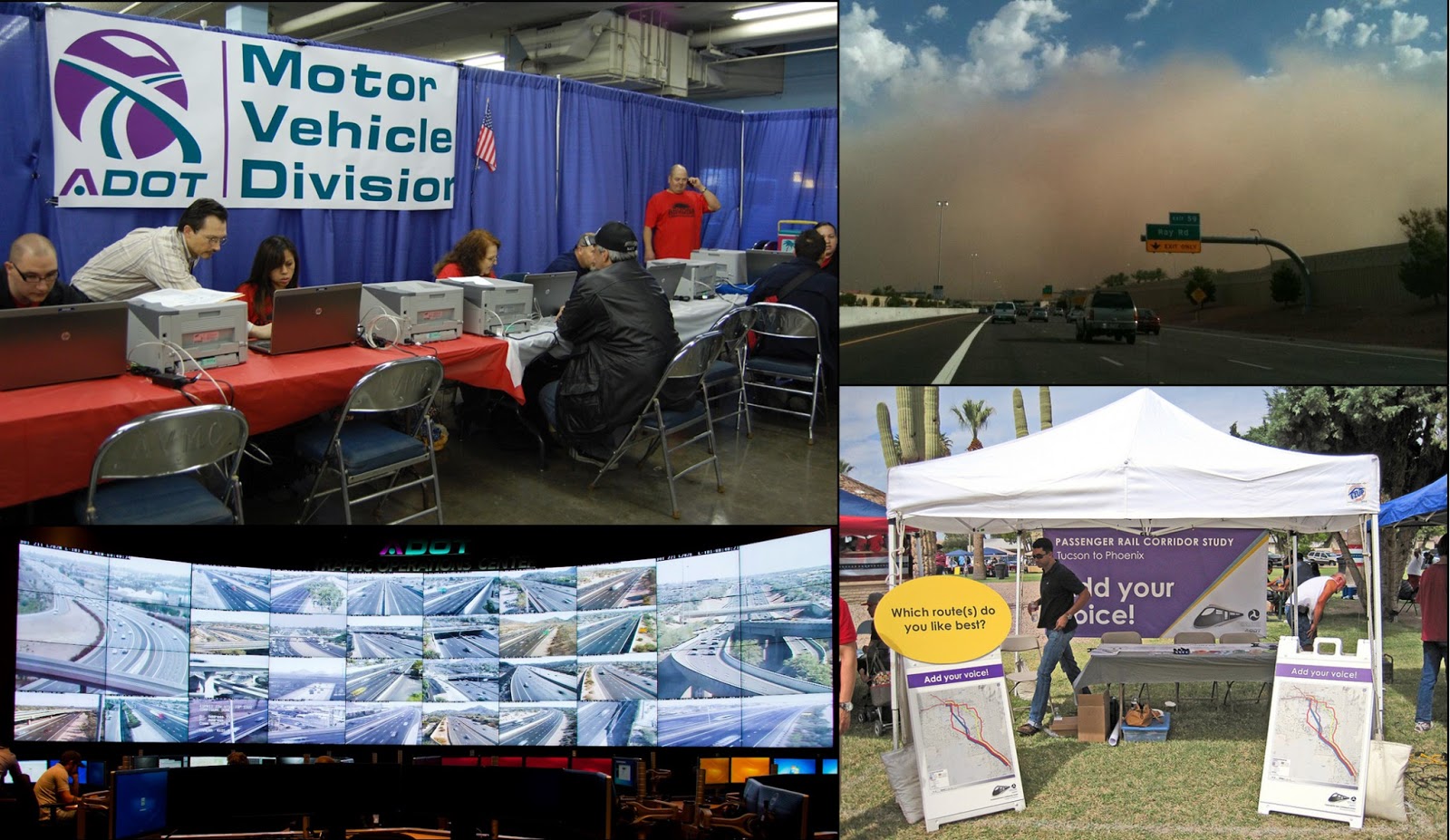
During the past year, ADOT identified six potential rail alternatives and one express bus alternative that could link Phoenix and Tucson and relieve expected congestion along I-10 in the future. This fall, ADOT held its second public comment period to gather input from community members about what they think about passenger rail. Nearly 3,000 people filled out a survey at community events or online. ADOT expects to narrow the list to two or three alternatives in the spring of 2013. A final alternative will likely be announced towards the end of 2013.

Of course, no 2012 wrap-up would be complete without a look at the Motor Vehicle Division and Enforcement and Compliance Division …

Motor Vehicle Division
From a new process designed to increase security for hundreds of thousands of driver license customers to outreach for the homeless population, 2012 marked another busy year for the Motor Vehicle Division. While service to customers receives the most attention, revenue collection is a vital part of MVD responsibilities. This year MVD safely and efficiently accounted for nearly $1 billion in state revenue while conducting in excess of 16 million transactions in person, through the mail and online, an increase of 3 percent from one year ago. In addition to serving the general public, MVD continued to work closely with and improve services for its industry and government partners statewide, including motor carriers, motor vehicle dealers, law enforcement agencies and the courts.

Enforcement and Compliance Division
As a means of improving highway safety throughout Arizona, the Enforcement and Compliance Division has accomplished a number of milestones during 2012. Officers completed 14,137 commercial vehicle inspections that contributed to driver and vehicle safety. Enforcement and Compliance officers also weighed 7,926,224 commercial vehicles to ensure that vehicle weights are at the legal level, reducing deterioration of Arizona’s highway infrastructure. While highway safety is of utmost importance to the Enforcement and Compliance Division officers and customer service representatives, the division also generated $16,324,134 in revenue from the sale of 461,587 permits to the commercial vehicle industry. The division has also worked closely with other state, local and federal law-enforcement agencies to ensure that a broad highway safety program is implemented to secure the safety of the motoring public when traveling around and near commercial vehicles. In addition to enforcement activities, ADOT’s Executive Hearing Office resolved 18,101 cases, a 25 percent increase from last year.

But, wait … there’s more!
There are just a few more items we want to remember before we move on to 2013. These don’t necessarily fit into any category, but they’re significant nonetheless…

Pull Aside, Stay Alive
Prior to the start monsoon season, ADOT, in cooperation with the Governor’s Office of Highway Safety, the Arizona Department of Public Safety and the National Weather Service, launched a public awareness campaign urging drivers to Pull Aside Stay Alive when they encounter a dust storm. As part of the campaign, ADOT used social media to engage the public and asked people to show off their creativity by submitting short poems about the dangers of dust storms and more than 1,500 haikus were submitted in one week.

Traffic Operations Center Upgrades
In September, ADOT unveiled its new Traffic Operations Center, which underwent a $2.1 million facelift. This high-tech control center, based in Phoenix, underwent a comprehensive refurbishment, including the addition of 40 reconfigurable 55-inch flat-panel displays, providing state-of-the art tools for the 24/7 facility. The upgrades to the center’s communications system allow ADOT staff to keep an eye on traffic conditions around the state and provide options for motorists to avoid congestion.

OK … it was nice to look back, but starting next week we’ll be back to blogging about ADOT’s present and future. Thanks for following along!

27 novembre 2012

Transportation Defined: Pavement Design Life

After 300-plus blog posts, you’d think that by now we’d have covered everything there possibly is to know about pavement...

But you’d be wrong.

Certainly, it’s not from a lack of trying – we’ve blogged about quiet pavement, pavement at airports, pavement materials testing, pavement markers and even the impact weather and climate can have on pavement. Oh, and remember when we explained how our crews are able to make sure pavement is as smooth as it can be (bonus points if you can recall how a profilograph works)?

It’s just that there’s so much to know about pavement (we’re not kidding – there really is) that we haven’t even scratched the surface.

Which brings us to today’s topic: pavement design life.

Pavement design life is a term that engineers use when they’re planning to build a new road or maintain an existing roadway. They’ll also use a number of years to go along with it, for example: 10-year pavement design life, 20-year pavement design life, etc.

The phrase should not be taken to imply that a road is only being built to survive for a set number of years. What it does represent is the road’s age at which some preventative maintenance or reconstruction will be considered so the road can continue to be durable and useful for the traffic it’s serving.

“For a typical highway, we generally will design an asphalt pavement for 20 years,” said ADOT Pavement Design Group Manager Paul Burch. “It does not mean that the road’s going to be falling apart and rubble in 20 years.”

A little more on pavement design…
Burch says that when engineers want to build a road, they take a lot into consideration, including soil condition, location, expected traffic levels and the area’s climate. Once those factors are determined – and the engineers know the pavement design life they want to build for – design begins.

All those conditions play a role in how the pavement is designed. Say, for example, the road’s being built in an area that gets very cold weather. If that’s the case, engineers will adjust the asphalt pavement mix to account for the temperature extremes.

Now, what if there’s a road that was constructed decades ago that’s not serving the traffic levels very well … can it be built up to a 20-year pavement design life?

Of course it can!

“What we would do if we were to inherit a road like that is we’d start by getting soil samples to test so we can determine what the strength of the soil is. Or, we could do Falling Weight Deflectometer testing so we could determine the strength of the existing roadway and the underlying soils through a method called 'Back Calculation.' From there, we would estimate what our traffic level would be and what design life we would want to design for,” said Burch, adding that the next step would be to create a design that takes all those important factors into account.

For more on pavement, check out our previous blog posts. And, stay tuned – we promise there are more pavement posts to come!

Transportation Defined is a series of explanatory blog posts designed to define the things you see on your everyday commute. Let us know if there's something you'd like to see explained ... leave a comment here on the blog or over on our Facebook page!